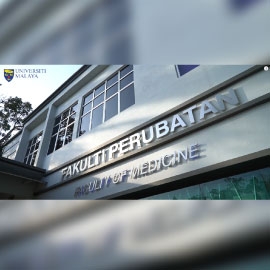




Discover our academic programmes, research excellence and global opportunities.

Practical programmes designed for future healthcare professionals.

Inspiring the next generation of doctors and healthcare leaders.

Expand your knowledge through advanced medical education.

Innovative research shaping the future of medicine and healthcare.

Clinical learning opportunities for local and international students.

Connecting our faculty through strategic communication and digital engagement.
Connecting students, alumni and societies.
Discover our legacy in medical education and healthcare.
Under the Straits Legislative Council of Malaya, the Straits and Federated Malay States Government Medical School was established with 17 medical students.
The school was renamed as the King Edward VII Medical School.
The King Edward VII Medical School was elevated in status to become the King Edward VII College of Medicine. The Department of Dentistry was established a few years later in 1927.
Raffles College was set up in 1928 with an inaugural batch of 43 students as a college for higher education in the arts and sciences.
The Carr-Saunders Commission on tertiary education in Malaya recommended King Edward VII College of Medicine and Raffles College to be merged into the University of Malaya.
Following the Carr-Saunders Commission Report, major changes in governance and infrastructure led to the division of the university into two autonomous campuses in Kuala Lumpur and Singapore.
The University Statute established the Faculty of Medicine (FOM) in September 1962 after the Board of Studies recommended that a medical faculty be set up in Kuala Lumpur to produce 100 medical doctors annually in Malaya.
Dr. T.J. Daranaj assumed duty as the First Professor of Medicine and Foundation Dean of the Faculty on 1st February 1963. Forty pre-medical students were selected and admitted in May.
The first foundation of the University Hospital (now known as Universiti Malaya Medical Centre) was laid by Tun Abdul Razak bin Dato Hussein, Deputy Prime Minister of Malaysia. University Hospital admitted its first patients in March 1967.
Administrative Dean, Professor Dr. Ibrahim Yassin Al-Haj was appointed and entrusted with the responsibility for the development of a new Faculty of Dentistry. The Faculty of Dentistry Complex was completed and opened in 1975.
The Bachelor of Pharmacy programme was established under FOM in March 1995, driven by the need to produce more pharmacists for the healthcare sector. The Department of Pharmacy was established and opened its doors to its first batch of thirty-six pharmacy students.
The Universiti Malaya Specialist Centre (UMSC) is established as an initiative by Universiti Malaya and FOM to halt the "brain drain" of medical experts from public sector to the private.
Construction of the UMSC building was completed, becoming 'Malaysia's Premier Public Quaternary Hospital' with more than 270 multidisciplinary specialists.
The Faculty of Pharmacy was officially announced as the newest Faculty in Universiti Malaya.
Strategic planning commenced to align all medical and health faculties and operations under UMHealth, comprising of the Faculty of Medicine, Dentistry, Pharmacy, UMMC and UMSC. UMHealth is expected to be launched in 2023.